There is an exciting sign of things to come if the world really is to move to address climate change. The European Union's Institute for Energy is backing proposals for a massive solar power project (ie the size of Wales) in North African deserts. Massive sums will have to be found for the distribution system, but there is the potential for Europe to meet all its energy needs from this project, according to this report in The Guardian:
http://www.guardian.co.uk/environment/2008/jul/23/solarpower.windpower
There are some provisos as to whether the political will for action will be forthcoming. The key one is, of course, economic. According to the Guardian article, an investment of Euros 450 billion is required for a distribution system to provide 100 GW by 2050. There is the potential for solar systems to provide energy more cheaply than other methods. Renewable energy is becoming even more feasible as oil prices rise, and they will inevitability rise further as increased demand for energy chases finite oil resources, which are widely believed to be past their peak already.
But it is not quite as rosy as it may appear - and reminds me of some sandwiches I bought once when catching the train to London from Cambridge (more on those in a moment). The rising oil price is having another effect. In Brazil it is now becoming economically viable to tap oil reserves that lie below many kilometres of rock off the coast of Rio de Janeiro. Yesterday the Secretary for Economic Development for Rio de Janeiro State said the country must capitalise on the high price of oil. In the US the cost of oil is prompting ever louder calls for reserves off the coast of California and Florida and in the Gulf of Mexico to be tapped.
Supply and demand increasing the price of oil is clearly not going to address the problem of carbon emissions or peak oil if it leads to an increase in oil production. As another example, Gordon Brown recently appealed to Middle Eastern countries to increase oil production to help meet demand and damp down prices. See:
http://globaljusticeideas.blogspot.com/2008/06/gordon-brown-in-saudi-arabia.html
Ideas under discussion within the Simultaneous Policy democratic process offer better solutions. Contraction & Convergence envisions a reduction of emissions to sustainable levels, with equitable distribution of the right to emit. The Oil Depletion Protocol proposes a managed weaning off of oil. It seems that whatever approach is taken, there is merit in taxing carbon emissions rather than trading them as trading does not necessarily provide an incentive to develop new, cleaner technologies.
Which brings me to my sandwiches, bought at Cambridge train station. They were organic, packaged with cardboard from recycled sources and the transparent film was made from cellulose and so 100% bio-degradeable. They were perhaps the most sustainable sandwiches I have ever bought. There are some that argue that we should rely on consumers favouring such products to change business practices. They argue that instead of imposing regulations, companies should be encouraged - and rewarded - for showing Corporate Social Responsibility, in other words, doing the right thing voluntarily. They would point to my sandwiches as an example of this working.
I see the lesson of the sandwiches differently. This product was the only one that had gone the sustainable route. If, however, there was a requirement that manufacturers of goods had to use recyclable or bio-degradable components wherever possible and take responsibility for processing any that are not (a so-called circular economy rather than a linear economy - see this clip on Youtube), then sustainable products would be the norm, rather than the exception. We need to be moving in this direction as, by definition, the world cannot survive unsustainably for ever.
Another example more directly linked to climate change, comes from my previous life as an electronic engineer. I worked on a computer-controlled diesel engine. The motivation for this research and development project was new European Union regulations on emissions which could not be met with conventional mechanical pumps. Greater control of the engine was required to improve efficiency and so reduce emissions. The main pump manufacturers were competing to produce the best solution and win orders from car manufacturers.
The Simultaneous Policy aims to provide the framework to prompt the innovation and other changes required to address global problems. Present mechanisms of commodity trading ramping up prices and emissions trading offsetting emissions may not quite do it when it comes to climate change and peak oil. We need the coherent set of policies being developed through the Simultaneous Policy campaigns democratic and transparent process (you can join in with proposals and cast your vote by signing up as a Simultaneous Policy Adopter on the official websites). The implementation strategy means that powerful vested interests that currently divert and undermine political effort are side-stepped.
The news on solar power stations is a sign that there is a way through the transition to a sustainable economy. We just need to provide the framework to make things like this happen. Play your part by signing up as an Simultaneous Policy Adopter.
Showing posts with label peak oil. Show all posts
Showing posts with label peak oil. Show all posts
July 23, 2008


June 30, 2008
The Oil Depletion Protocol in the UK media - but no mention of SP
Michael Meacher MP, former UK Environment Minister, has written on a national newspaper website yesterday about peak oil and, in particular, the Rimini Protocol (or Oil Depletion Protocol), which received 69% support from Simultaneous Policy campaign supporters (SP Adopters) in the last annual voting round.
Sadly Mr. Meacher does not mention the Simultaneous Policy as a way to achieve action on peak oil. I have posted a comment to the website referring to the past support for the Rimini Protocol within SP and encouraging people to investigate the campaign.
The more people that can post similar messages, the more likely visitors to the site will see them and investigate.
The article is at:
http://www.guardian.co.uk/commentisfree/2008/jun/29/oil.oilandgascompanies
Mr. Meacher's article includes the following:
“The most direct means of constraining world demand would be the proposed Rimini protocol, which prescribes that oil-importing countries cut their imports to match the world depletion rate (ie annual production as a percentage of remaining global reserves) now running at about 2% a year. Of course, the fundamental political problem remains that the most powerful oil-hungry countries will not agree. If not Kyoto, why Rimini?”
To send a letter to the Editor of The Guardian, email letters@guardian.co.uk (with full contact details):
Here is my effort:
“Michael Meacher MP, former Environment Minister, highlights the Rimini Protocol for addressing depletion of oil reserves, but raises the difficulty of oil-hungry countries being persuaded to support this strategy for weaning us off oil, which will also help in addressing climate change. The Simultaneous Policy (SP) campaign is succeeding in persuading a growing number of politicians to pledge to implement, alongside other governments, policies to effectively address global problems. Simultaneous implementation removes the fear that unilateral action will harm competition and so the national economy. The Rimini Protocol gained 69% support in the last annual round of voting. SP is not an alternative to other forms of advocacy, but has the potential to achieve far more. By registering with the campaign, participating and voting in policy discussions and/or calling on politicians to make the SP pledge, everyone can help the transformation to people-led cooperation between nations.”
Mike Brady
Coordinator Cambridge SP Adopters Group
http://www.simpol.org.uk/
The Simpol forum talkboard on the Oil Depletion Protocol is at:
http://www.simpol.org.uk/forum/index.php?topic=4.0
Sadly Mr. Meacher does not mention the Simultaneous Policy as a way to achieve action on peak oil. I have posted a comment to the website referring to the past support for the Rimini Protocol within SP and encouraging people to investigate the campaign.
The more people that can post similar messages, the more likely visitors to the site will see them and investigate.
The article is at:
http://www.guardian.co.uk/commentisfree/2008/jun/29/oil.oilandgascompanies
Mr. Meacher's article includes the following:
“The most direct means of constraining world demand would be the proposed Rimini protocol, which prescribes that oil-importing countries cut their imports to match the world depletion rate (ie annual production as a percentage of remaining global reserves) now running at about 2% a year. Of course, the fundamental political problem remains that the most powerful oil-hungry countries will not agree. If not Kyoto, why Rimini?”
To send a letter to the Editor of The Guardian, email letters@guardian.co.uk (with full contact details):
Here is my effort:
“Michael Meacher MP, former Environment Minister, highlights the Rimini Protocol for addressing depletion of oil reserves, but raises the difficulty of oil-hungry countries being persuaded to support this strategy for weaning us off oil, which will also help in addressing climate change. The Simultaneous Policy (SP) campaign is succeeding in persuading a growing number of politicians to pledge to implement, alongside other governments, policies to effectively address global problems. Simultaneous implementation removes the fear that unilateral action will harm competition and so the national economy. The Rimini Protocol gained 69% support in the last annual round of voting. SP is not an alternative to other forms of advocacy, but has the potential to achieve far more. By registering with the campaign, participating and voting in policy discussions and/or calling on politicians to make the SP pledge, everyone can help the transformation to people-led cooperation between nations.”
Mike Brady
Coordinator Cambridge SP Adopters Group
http://www.simpol.org.uk/
The Simpol forum talkboard on the Oil Depletion Protocol is at:
http://www.simpol.org.uk/forum/index.php?topic=4.0
June 23, 2008
Gordon Brown in Saudi Arabia and in a political bind
There is a good analysis of the bind the UK Prime Minister is in when trying to form policy to cope with climage change and rising oil prices. It comes in an Observer article by Andrew Rawnsley entitled: "Don't rely on the boys with the black stuff, Mr Brown" and concerns Gordon Brown's attempt to get Middle East oil producers to pump more oil.
'Voters' say they want action on climate change, but call for contrary action when their own financial interests are at stake.
Another good opportunity to flag up the need for the Simultaneous Policy campaign. See:
http://www.guardian.co.uk/commentisfree/2008/jun/22/greenpolitics.gordonbrown
This is the comment I left:
---
This is a good analysis and we have to hope that politicians can lead the debate and explain why a low-carbon economy is better than pumping more oil to keep the price down.
I do take slight issue with this comment, however: "The culprit is easy to identify. I blame the voters. When they told pollsters that the environment was high in their concerns, the politicians made it high in theirs. With the economy sagging and the cost of essentials rising, the understandable response of voters is to tell the opinion pollsters that they are now less bothered about the planet and much more agitated about taxation and inflation."
It is true as far as it goes. But we need to go further. The reason why the government tried to backtrack on its commitments to the European Emissions Trading Scheme was pressure from business interests, which threatened that investment and jobs would move overseas if UK targets were too demanding. That would harm the economy and lose votes. So such pressure works and will continue to work.
Unless the voters can regain their democratic rights. A way to do so - as well as demonstrating and writing to MPs - is to support the Simultaneous Policy campaign, which brings people together around the world to discuss and agree the policies they wish to see implemented to address global problems and calls on politicians to pledge to implement them alongside other governments. Simultaneous implementation breaks the power of vested interests. Politicians from all major parties in Parliament are already signing up. The more voters that support the Simultaneous Policy, the more MPs that will pledge to implement it and the sooner that will become government policy, moving us closer to implementation.
It's not an alternative to other action, but can potentially take us far further, such as to implementation of the 'Contraction and Convergence' approach to climate change which is gaining support in the annual Simultaneous Policy voting rounds.
---
This meeting takes place as a new opinon poll in the UK suggests that there is still a lot of confusion about climate change, with 60% incorrectly believing "many scientific experts still question if humans are contributing to climate change."
The information sharing role of the SP campaign has a role to play here. Amongst SP Adopters (anyone can sign up for no charge), in the last annual voting round 80% put climate change as the top global problem they want to see addressed.
The need for its strategy of putting people in charge of leading politicians is demonstrated by the lack of confidence those polled put in their leaders. According to The Guardian:
"More than half of those polled did not have confidence in international or British political leaders to tackle climate change, but only just over a quarter think it's too late to stop it. Two thirds want the government to do more but nearly as many said they were cynical about government policies such as green taxes, which they see as 'stealth' taxes."
See:
http://www.guardian.co.uk/environment/2008/jun/22/climatechange.carbonemissions
There is a lot of action taking place at more local level, sometimes motivated by the lack of it at national level, as with New Mexico's solar panel fields and Renewable Portfolio Standard (RPS).
As The Guardian reports: "Although 25 states have approved their own RPS, a national standard has stalled in the face of resistance from traditional coal-powered utilities and their allies in Congress."
These innovations show that contraction of carbon emissions is possible. The introduction of a global strategy of Contraction and Convergence would serve as a motor for further innovation and provide a global market for the technology, so bringing down prices.
Technology isn't the whole answer, but those in early with refining technology are likely to see great benefits.
'Voters' say they want action on climate change, but call for contrary action when their own financial interests are at stake.
Another good opportunity to flag up the need for the Simultaneous Policy campaign. See:
http://www.guardian.co.uk/commentisfree/2008/jun/22/greenpolitics.gordonbrown
This is the comment I left:
---
This is a good analysis and we have to hope that politicians can lead the debate and explain why a low-carbon economy is better than pumping more oil to keep the price down.
I do take slight issue with this comment, however: "The culprit is easy to identify. I blame the voters. When they told pollsters that the environment was high in their concerns, the politicians made it high in theirs. With the economy sagging and the cost of essentials rising, the understandable response of voters is to tell the opinion pollsters that they are now less bothered about the planet and much more agitated about taxation and inflation."
It is true as far as it goes. But we need to go further. The reason why the government tried to backtrack on its commitments to the European Emissions Trading Scheme was pressure from business interests, which threatened that investment and jobs would move overseas if UK targets were too demanding. That would harm the economy and lose votes. So such pressure works and will continue to work.
Unless the voters can regain their democratic rights. A way to do so - as well as demonstrating and writing to MPs - is to support the Simultaneous Policy campaign, which brings people together around the world to discuss and agree the policies they wish to see implemented to address global problems and calls on politicians to pledge to implement them alongside other governments. Simultaneous implementation breaks the power of vested interests. Politicians from all major parties in Parliament are already signing up. The more voters that support the Simultaneous Policy, the more MPs that will pledge to implement it and the sooner that will become government policy, moving us closer to implementation.
It's not an alternative to other action, but can potentially take us far further, such as to implementation of the 'Contraction and Convergence' approach to climate change which is gaining support in the annual Simultaneous Policy voting rounds.
---
This meeting takes place as a new opinon poll in the UK suggests that there is still a lot of confusion about climate change, with 60% incorrectly believing "many scientific experts still question if humans are contributing to climate change."
The information sharing role of the SP campaign has a role to play here. Amongst SP Adopters (anyone can sign up for no charge), in the last annual voting round 80% put climate change as the top global problem they want to see addressed.
The need for its strategy of putting people in charge of leading politicians is demonstrated by the lack of confidence those polled put in their leaders. According to The Guardian:
"More than half of those polled did not have confidence in international or British political leaders to tackle climate change, but only just over a quarter think it's too late to stop it. Two thirds want the government to do more but nearly as many said they were cynical about government policies such as green taxes, which they see as 'stealth' taxes."
See:
http://www.guardian.co.uk/environment/2008/jun/22/climatechange.carbonemissions
There is a lot of action taking place at more local level, sometimes motivated by the lack of it at national level, as with New Mexico's solar panel fields and Renewable Portfolio Standard (RPS).
As The Guardian reports: "Although 25 states have approved their own RPS, a national standard has stalled in the face of resistance from traditional coal-powered utilities and their allies in Congress."
These innovations show that contraction of carbon emissions is possible. The introduction of a global strategy of Contraction and Convergence would serve as a motor for further innovation and provide a global market for the technology, so bringing down prices.
Technology isn't the whole answer, but those in early with refining technology are likely to see great benefits.
June 13, 2008
Fuel running out at UK petrol stations - a message from the future
There is panic buying of fuel in the UK at the moment as tanker drivers for Shell go on strike. See:
http://www.guardian.co.uk/uk/2008/jun/13/transport.oil1
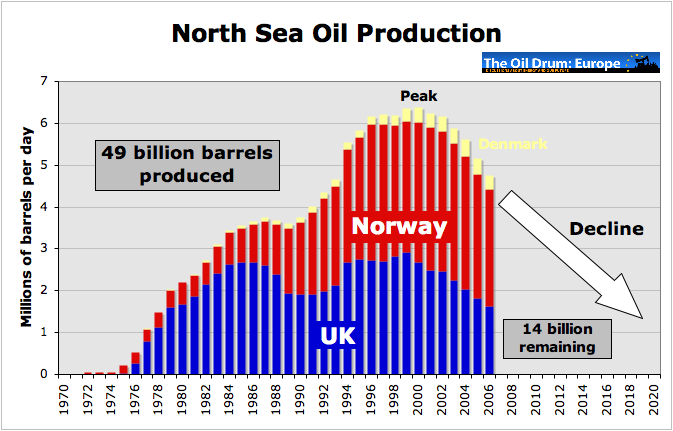
The strike is over pay, but the panic buying is a sign of things to come according to analysts who suggest that we are at Peak Oil - the point where all conceivable reserves are remaining oil are less than that already used.
Here is a graphic example of the situation with North Sea Oil, taken from the site The Oil Drum: (thanks to Chris for including this in a comment on the article I posted on Indymedia).
 As I wrote recently, the price increases in oil, which have also caused panic, is explained by some by this reality (some say it is down to speculators playing the market). See:
http://globaljusticeideas.blogspot.com/2008/06/price-of-oil.html
The suggestion from the British Prime Minister that prices should be reduced by increasing pumping from the North Sea shows how blinkered politicians are over this problem. We have a finite resource, past its peak and demand is rising. How is increasing supply to reduce prices a sensible management strategy?
Take a look at the queues of motorists at petrol stations in the UK, stations running dry and the knock on effects, which could tip the UK economy into recession. You are looking at the future under the leadership offered by both the current government and the opposition.
There needs to be a better thought through strategy. One proposal put forward by a Simultaneous Policy Adopter is the Oil Depletion Protocol. You can find out more about that on the talkboard for the policy suggestion at:
http://www.simpol.org.uk/forum/index.php?topic=4.0
Also see the website of the Oil Depletion Analysis Centre.
http://www.odac-info.org/
I'll write more on this and alternative policy suggestions in future blogs. Please do sign up as an SP Adopter and join in the discussion on the talkboards.
Call on your elected representatives to sign the pledge to implement the Simultaneous Policy alongside other governments as a parallel strategy to any other action you may take.
http://www.guardian.co.uk/uk/2008/jun/13/transport.oil1
The strike is over pay, but the panic buying is a sign of things to come according to analysts who suggest that we are at Peak Oil - the point where all conceivable reserves are remaining oil are less than that already used.
Here is a graphic example of the situation with North Sea Oil, taken from the site The Oil Drum: (thanks to Chris for including this in a comment on the article I posted on Indymedia).
 As I wrote recently, the price increases in oil, which have also caused panic, is explained by some by this reality (some say it is down to speculators playing the market). See:
http://globaljusticeideas.blogspot.com/2008/06/price-of-oil.html
The suggestion from the British Prime Minister that prices should be reduced by increasing pumping from the North Sea shows how blinkered politicians are over this problem. We have a finite resource, past its peak and demand is rising. How is increasing supply to reduce prices a sensible management strategy?
Take a look at the queues of motorists at petrol stations in the UK, stations running dry and the knock on effects, which could tip the UK economy into recession. You are looking at the future under the leadership offered by both the current government and the opposition.
There needs to be a better thought through strategy. One proposal put forward by a Simultaneous Policy Adopter is the Oil Depletion Protocol. You can find out more about that on the talkboard for the policy suggestion at:
http://www.simpol.org.uk/forum/index.php?topic=4.0
Also see the website of the Oil Depletion Analysis Centre.
http://www.odac-info.org/
I'll write more on this and alternative policy suggestions in future blogs. Please do sign up as an SP Adopter and join in the discussion on the talkboards.
Call on your elected representatives to sign the pledge to implement the Simultaneous Policy alongside other governments as a parallel strategy to any other action you may take.
Subscribe to:
Posts (Atom)


